Skip to content
Bhutan, Beyond the Ordinary

Thimphu Tshechu

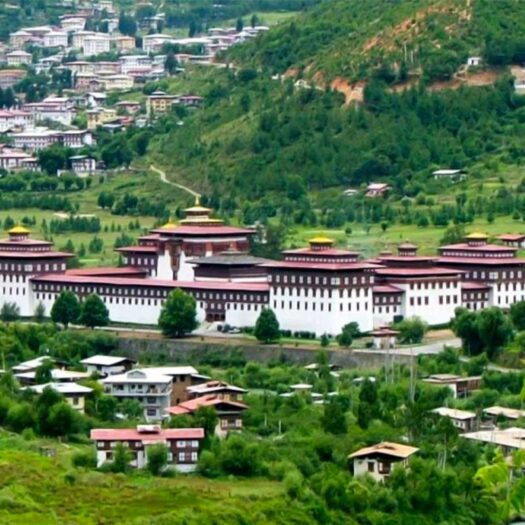
Every autumn, the quiet rhythm of Thimphu shifts as thousands of residents from nearby valleys arrive at Tashichho Dzong. Dressed in handwoven silk ghos and kiras, families gather for three days to witness the sacred mask dances (chams). The dances are religious rites designed to cleanse karmic obstacles, retell Buddhist folklore, and unify the community.

This 7-day journey balances the living energy of the festival with quiet valley exploration. You will cross high mountain passes into subtropical Punakha, share lunch with local families, walk terraced village paths, and conclude with the pilgrimage up to Tiger’s Nest.

“Standing shoulder-to-shoulder with local families in the dzong courtyard, you realize this isn’t staged theater. The resonance of long copper horns against the stone walls and the laughter triggered by the Atsara jesters show you how deeply religion and community interlock in daily Bhutanese life.”

Excerpt compiled from TripAdvisor, Lonely Planet travel logs, and local guide accounts.
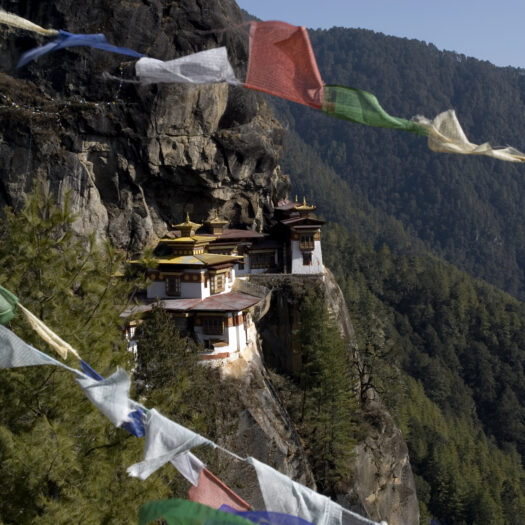
Thimphu Tshechu, Tashichho Dzong: Masked monks perform ancient sacred chams in the stone grand courtyards of the seat of government. Taktsang Goemba (Tiger’s Nest), Paro: A 900-meter vertical pine forest trail leading to the 8th-century cliffside retreat. Punakha Dzong: The 17th-century fortress situated at the junction of the Pho Chhu and Mo Chhu rivers. Dochula Pass (3,100m): High Himalayan ridge crowned with 108 memorial stupas overlooking eastern snow peaks. Centenary Farmers Market, Thimphu: Open-air riverfront stalls trading dried cheese (chhurpi), wild forest mushrooms, and incense powders.
Distance
54 km
Travel Duration
1.5 hours
Min Altitude
2,250 m
Max Altitude
2,334 m

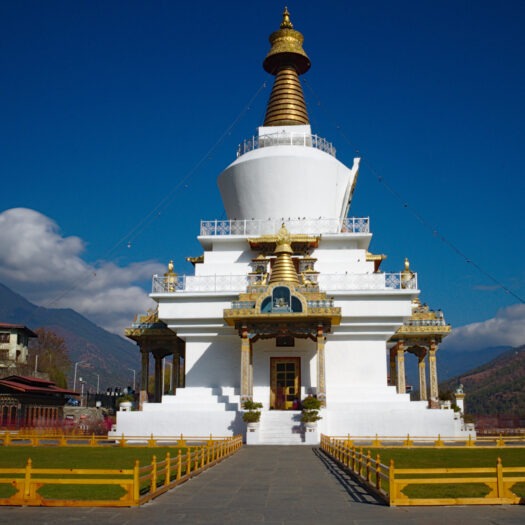
Land at Paro International Airport, tucked into a narrow mountain valley. Meet your local guide and driver, following the river confluence down toward the capital. Take a quiet evening walk around the National Memorial Chorten, where Thimphu residents gather to spin prayer wheels after work.

National Memorial Chorten Feature Image

Constructed in 1974 in memory of the Third King of Bhutan, Jigme Dorji Wangchuck, this Tibetan-style stupa stands at the spiritual heart of downtown Thimphu. Unlike classical chortens that enshrine human relics, this monument represents the mind of the Buddha, topped with a golden finial and adorned with intricate wood…

Distance
10 km
Travel Duration
30 minutes driving total
Min Altitude
2,334 m
Max Altitude
2,334 m

Walk into the outer courtyards of Tashichho Dzong alongside thousands of local spectators. Spend the day observing sacred rites like the Dance of the Four Stags and the Dance of the 21 Black Hats. Local field notes suggest taking short breaks along the Wangchhu riverbank to try wild mushroom broth from festival food stal

Tashichho Dzong (Fortress of the Glorious Religion) Feature Image

Positioned on the banks of the Wang Chhu river, this 13th-century fortress serves as the seat of the Royal Government of Bhutan and the summer residence of the Je Khenpo (Chief Abbot) and the Central Monastic Body. Reconstructed in traditional fashion in 1962 without iron nails or blueprint drawings, the…

Distance
30 km
Travel Duration
2–3 hours total
Min Altitude
2,334 m
Max Altitude
2,650 m

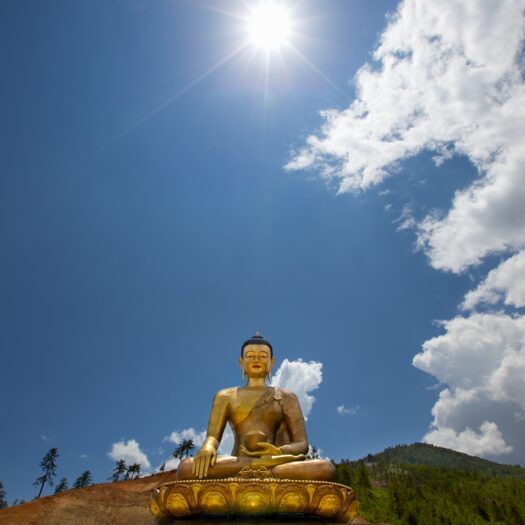
Drive up to Kuenselphodrang ridge to stand at the base of the 51-meter bronze Buddha Dordenma, looking across the entire valley. Continue to Changangkha Lhakhang—a 12th-century fortress-temple where parents bring newborns for blessings—and visit the National Institute for Zorig Chusum to watch students practice traditional arts.

Buddha Dordenma (Buddha Point) Feature Image

Rising 51.5 meters above the valley floor at Kuensel Phodrang, this colossal bronze and gilded statue of Shakyamuni Buddha anchors the southern skyline of Thimphu. Built to fulfill an ancient prophecy of peace and global harmony, the massive exterior conceals a grand three-story temple hall housing 125,000 smaller bronze Buddha…

Institute for Zorig Chusum (School of Arts and Crafts) Feature Image

Trashi Yangtse is Bhutan's premier hub for master woodcarvers and artisans who specialize in making traditional wooden bowls and cups (Dapa). The local branch of the Institute for Zorig Chusum trains young students in Bhutan's 13 traditional arts, emphasizing woodcarving, painting, and embroidery. Visitors to the institute can observe students…

Distance
76 km
Travel Duration
2.5 hours
Min Altitude
1,242 m
Max Altitude
3,100 m

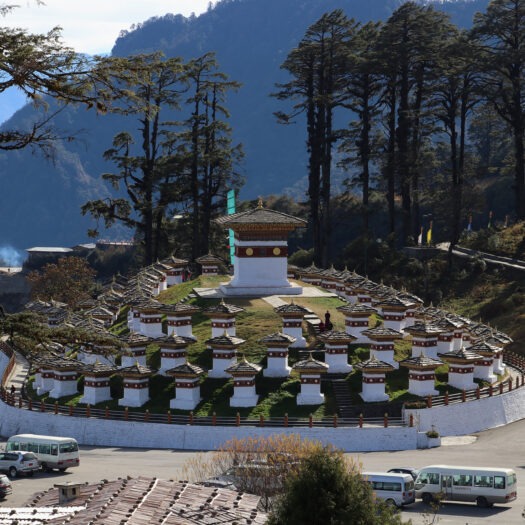
Ascend through pine and hemlock forests to Dochula Pass, stopping to view the 108 Druk Wangyal Chortens. On clear days, the entire northern range along the Tibetan border is visible. Descend into the warm Punakha valley and take a gentle afternoon walk through paddy fields to Chimi Lhakhang.

Dochula Pass Feature Image

Perched at an elevation of 3,100 meters along the mountain highway connecting Thimphu to Punakha, Dochula Pass is one of Bhutan’s most iconic and spiritually charged mountain crossings. The crest of the pass is crowned by the 108 Druk Wangyal Chortens, a terraced mandala of whitewashed stupas commissioned in 2004…

Chimi Lhakhang Feature Image

Perched on a round hillock in the fertile agricultural basin of Sopsokha, Chimi Lhakhang is a 15th-century sanctuary founded by Ngawang Chogyal and sanctified by the eccentric saint Drukpa Kunley, famously known as the "Divine Madman." Renowned throughout the region as a fertility temple, it attracts couples from across Bhutan…

Distance
130 km
Travel Duration
4 hours
Min Altitude
1,242 m
Max Altitude
3,100 m

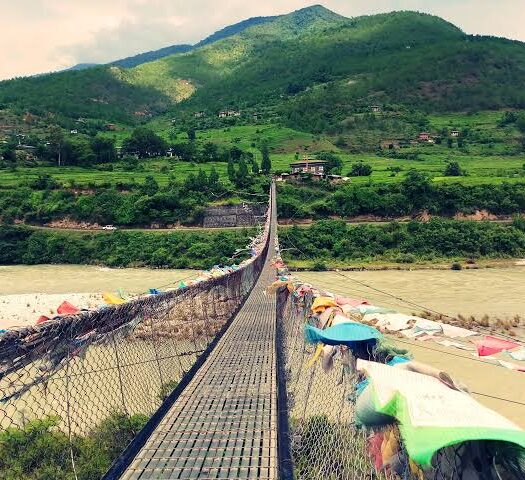
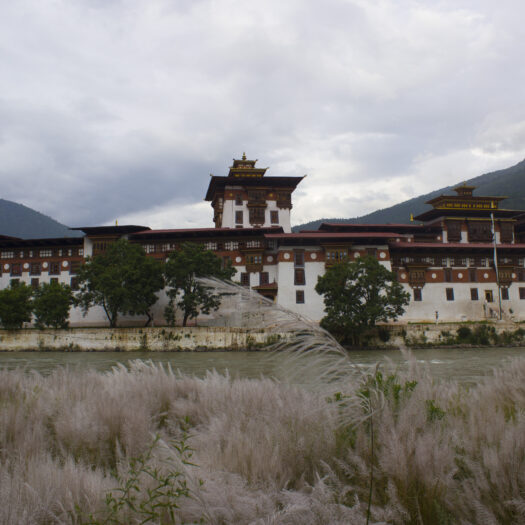
Tour Punakha Dzong in the morning, exploring its whitewashed courtyards, ancient assembly halls, and carved timberwork. Cross Bhutan’s longest suspension bridge spanning the Pho Chhu river before retracing your drive over Dochula Pass to Paro Valley.

Punakha Dzong (Pungtang Dechen Photrang) Feature Image

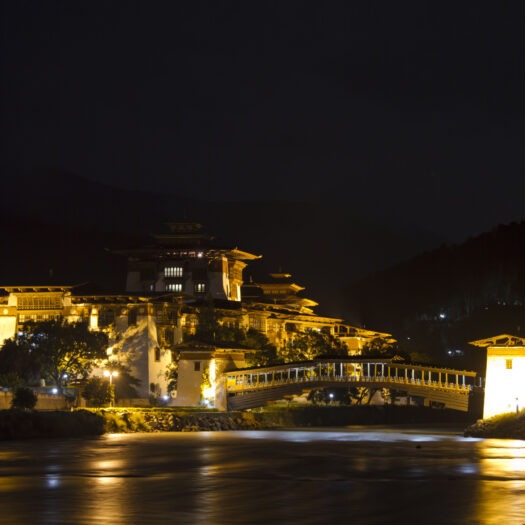
Commanding the junction where the Pho Chhu (father) and Mo Chhu (mother) rivers meet, Punakha Dzong is widely regarded as the pinnacle of classical Bhutanese fortress architecture. Constructed in 1637 by Zhabdrung Ngawang Namgyal, this massive citadel served as Bhutan’s seat of government until the mid-20th century and remains the…

Punakha Suspension Bridge Feature Image

Stretching approximately 160 meters across the rushing waters of the Pho Chhu river, the Punakha Suspension Bridge is one of the longest pedestrian suspension bridges in Bhutan. Originally constructed to link Punakha Dzong with the outlying farming villages of Shengana, Samdingkha, and Wangkha, the metal-cable span is festooned from end…

Kyichu Monastery Feature Image
Paro

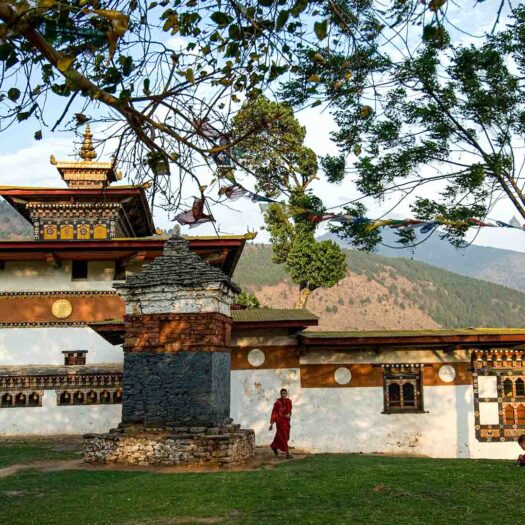
The Kyichu Monastery is considered to be one of the oldest temples in Bhutan and a popular place of pilgrimage for many Bhutanese. Lore has it that a Tibetan king called Songtsen Gompo built 108 temples in one day and Kyichu Lhakang was one of the them. Is it said…

Distance
10 km
Travel Duration
5–6 hours hiking
Min Altitude
2,250 m
Max Altitude
3,120 m

Start early to beat the sun on the uphill trail to Tiger’s Nest. The path switchbacks up through blue pine forests draped in Spanish moss, passing a waterfall before reaching the cliffside monastery. Return to the valley floor for a traditional hot stone bath infused with wild artemisia leaves.

Tigersnest Monastery Feature Image

The Taksang monastery is one of the most revered places of pilgrimage in Bhutan. Dedicated to Guru Padmasambhava, this incredible monastery clings to the edge of a sheer rock cliff that plunges 900 meters into the valley below. Legend has it that Guru Padmasambhava, chose a cave on a sheer…

Distance
10 km
Travel Duration
20 minutes
Min Altitude
2,250 m
Max Altitude
2,250 m

After breakfast, meet your driver and guide for the short transfer to Paro International Airport for your departing flight home.

Punakha Drubchen

7 Nights / 8 Days

Discover More
Paro Tshechu

7 Nights / 8 Days

Discover More
Enquire